
Preamble
Hey all, been a while! I want to do a quick and dirty post on blind picking champions to follow up on the excellent Broken By Concept Podcast on ADCs that was just released. Their talk about blinding champions got me thinking and made me want to put some data behind it.
As a refresher, I have now analyzed 25 million diamond plus games in 2024 for their win-rate corrected synergies and match-ups. By win rate corrected, I mean I find whether a duo of champions over-performs or under-performs their predicted duo win-rate from their individual win-rates. (Expected win-rate is calculated using -log10(1/(WR/100))-1 conversion as I mentioned in previous posts.) So for example, if Ezreal_Adc and Lux_Sup each have 52% WRs, we would expect them to have a duo WR of 53.99%. BUT if we find their WR is actually 55% (about 1% higher than predicted by their win-rates alone), it would indicate there is a positive synergistic interaction between Ezreal and Lux. That’s exactly how I’ve generated match-up and synergy matrices in previous posts.
What is Blindability?
Ok, with that out of the way, let’s get to today’s subject: blindability. How punishable is your champion? Is it ok to pick early?
First, let’s define blindability. I’ve divided blindability into two parts:
- Synergy Blindability: the gap between the best and worst synergies with other champions on your team
- Match-up Blindability: the gap between best and worst match-ups against champions on the opposing team.
In solo queue, a good blind pick must be both synergy and match-up blindable, because you can’t predict what your teammates will play (for the most part). In comp play, synergy blindability matters a bit less because your teammates can choose coherent champions, BUT… picking a champion with poor synergy blindability still limits what your teammates can pick, potentially stretching their pools or making counter-picking the enemy harder.
Measuring Blindability
Our synergy and match-up data is perfect for measuring blindability. The less variance in synergies and match-ups, the more blindable a champion is.
Measuring variance of a champion’s synergies and match-up is easy enough. We will use standard deviation (variance^.5). Let’s take a look at match-up variance:

Looks kind of good… but there’s a problem. Champions with low games-played have higher standard deviations. This makes sense, less games means each match-up will be farther from its true mean, so when you average those means it will appear more variable. For example, Kai’sa when we measure Kai’sa’s match-up vs champion X and champion Y and champion Z, her true means might be μX=0.47, μY=0.53, and μZ=0.50 when sample size -> ∞, but with a sample size of 1, μX=0, μY=1, and μZ=0. This is an extreme example, but you can see how more samples will eliminate variance for each match-up, and thus decrease the between-match-up variance. Darn. We need a work-around.
Fortunately, we know that each match-up win rate is a binomial distribution, and by nature of this distribution the variance will always be σ² = n * p * (1 – p). We can use this knowledge and a Method of Moments Estimation to correct for sample size in our match-up variance calculation. When we do, we get a True Standard Deviation Measurement:

Great! So the smaller the green bar, the closer together a champion’s good and bad match-ups are.
I also tried this only observing the highest and lowest 10% of match-ups but it didn’t really change the order much. So if you’re thinking wait what if a champion has one GIGACOUNTER, well maybe, but it seems like most champions who have strong counters are higher variance in general.
Make It Sexy
Ok, we could do the same with synergies, but let’s skip right to the punch-line. Let’s get some plots that will tell you everything you need to know, all-in-one.

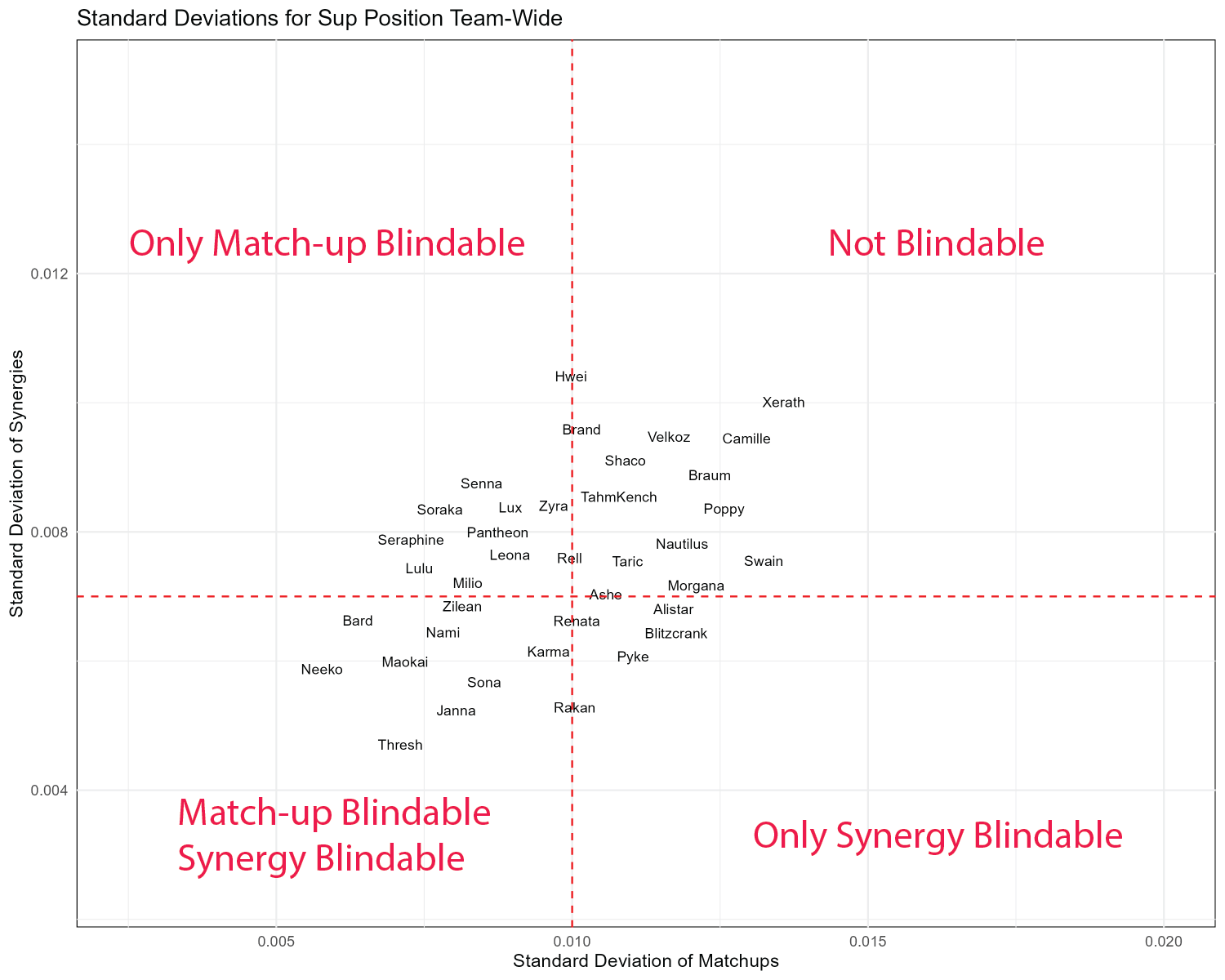
Here we have the Method of Moments corrected standard deviation of match-ups on the x-axis and synergies on the y-axis. I have arbitrarily drawn some quadrants and labeled what they indicate. Let’s look at some extremes. Thresh is blindable in match-up and synergy. His kit is flexible enough to be useful vs any team and with any team. Xerath is the opposite. Xerath is a specialist support that only works with heavy poke and vs non-engage.
Do note that these are match-ups and synergies team-wide. So Thresh’s synergy with the top laner is included with his synergy with the ADC and every other position. Same for match-up.


The red lines are arbitrarily placed and just for reference.
Note, you can see some unique positional trends:
1. Top laners are less match-up blindable but more synergy blindable. Your lane match-up matters so so much. Conversely, your interaction with the team matters much less.
2. Mids are mostly not blindable. Match-up and synergy matter so much for mid.
In-Lane Blindability
I don’t have the gold-at-15 measurements pulled yet, so we will skip this section for now. I’ll make a new post once I have them.
Take-Aways
This is a short post but one I feel is really important to draft in both Solo and competitive. One fascinating observation is that some multi-season pro staples like Lucian, Azir, Ahri, Jinx, Kai’sa, Thresh, Janna, Zeri, Ezreal, Oriana, Vi, etc are low variance both in match-up and synergy. They are flexible, and thus investing a ton of game onto them will give you a tool you can always use. Counter-pick is a luxury, solo-queue team comps are a toss-up, and if I were picking a new main I would definitely want a to invest in a champion that is both synergy and match-up blindable.


Leave a Reply to JayCancel reply