
7/28/2024 by Joseph Zinski
Edited 8/6/24 for green/red colorblind friendly colors
In this post I will detail support and ADC match-ups and synergies, mathematically derive the different classes of each, and show how these classes interact in the bot lane ecosystem. I’ve chosen to start with supports because I think league players have a strong intuitive understanding of the enchanter-engager-poke triangle of support classes. We confirm this relationship while expanding to 6 relevant classes.
Woah woah woah… what have you done?
You probably have questions. Where did I get my data? How did I analyze it? Is it consistent across patches and time? These questions deserve their own blog post, but its a less exciting one than the bot lane ecosystem so I thought I’d start here instead.
In brief, I have been pulling solo queue diamond+ league of legends games from the Riot api in major regions for the last 6 months accumulating over 10 million games. For each game, I have the champions selected and the winner. From this data, I determine champion win rates. I then determine:
– Synergies: What is the win rate when 2 champions are in the same game on the same team.
– Match-ups: What is the win rate when 2 champions are in the same game on opposite teams
These synergies and match-ups are just like the ones you get on lolalytics or u.gg.
I do some maths to correct for champion win rate so that win rate differences don’t interfere with my synergies and match-ups and viola! We are ready to look at champion similarities and differences.
Supports in the Bot Lane
We will start with something I know many of us have an intuition for, support laning match-ups. Here, I will examine all support match-ups against other supports and ADCs. Let’s take a look at the raw match-up data in the bot lane.

It’s pretty overwhelming right? Each row is a support, and each intersection is the match-up. For example in column 1 row 15 we see nautilus is -.02 WR vs Braum. That’s a 2% decrease in Nautilus’s win rate vs a Braum. Makes sense, Braum’s kit is well-suited to deal with Nautilus. But overall, it’s messy. Let’s do a trick to fix it.
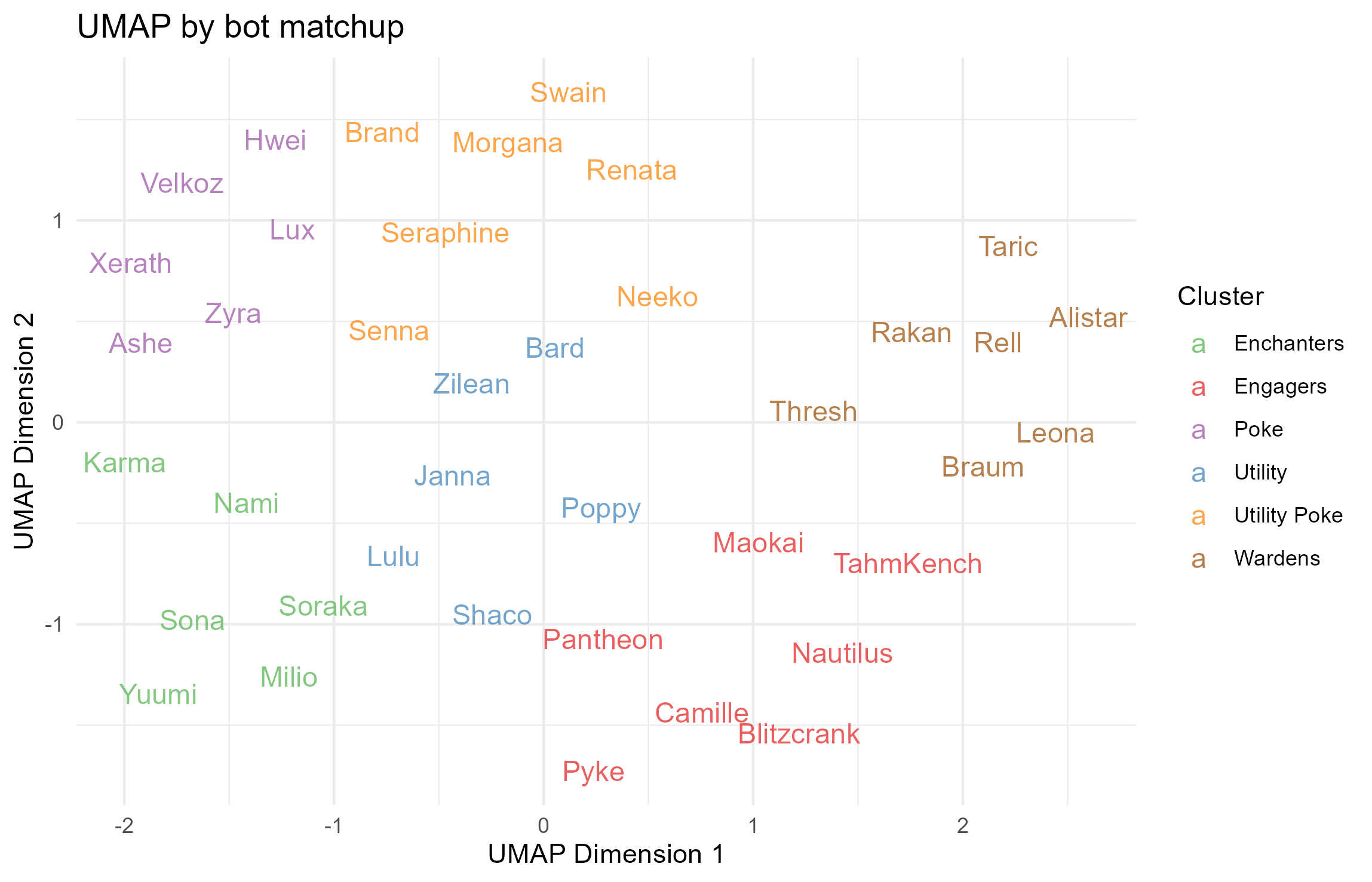
We will employ a UMAP (Uniform Manifold yada yada big words). In simplified terms, a UMAP here will group champions with more similar match-ups together.

Now we are talking! You can see some familiar groups emerging. Don’t worry about the axes, just know closer together means more similar. I’ve taken the liberty of using a Gaussian Mixture Model (GMM, more big words) to divide the groups up. 6 groups seemed most suitable, and I’ve colored the groups and given them names I find intuitive. You can also appreciate that even though I’ve divided them into 6 classes, some champions are at the borders, like Thresh who could moonlight as an Engager, Warden, or a Utility champion.
Now, let’s explore how the different classes match up with each other.

Suddenly, those intuitions we have about the support classes become readily apparent. Wardens beat Enchanters, Engage beats Enchanters, these I think you already had a feel for. However, our 6 classes starts to allow for more nuance. Utility Poke champions counter Wardens the hardest, providing just enough CC to nullify any feeble attempts Wardens make at engaging while still being able to poke and enchant. Poke counters Utility Poke by simply exploiting their relative lack of damage and range. The more you stare at it, the more it makes sense.
But keep in mind, these are average for all champions in each class. When we break down the classes, we can sometimes find outliers.

Yuumi, for example, is incredible versus Poke champions, better than other Enchanters, but is far worse versus Wardens. Swain is better than most Utility Poke versus Wardens and Engagers while being worse against everything else. And sometimes, individual match-ups are just unplayable. Nami eats Taric’s lunch in a way other Enchanters just don’t.
Excellent! So we’ve established 6 support classes and can appreciate how they interact. But wait, what happened to the ADCs? I stopped talking about them after Figure 1. Let’s circle back.
ADCs in the Bot Lane
Let’s start at the same place for ADCs. This will be interesting, because unlike support I think most of us have a less intuitive understanding of how ADC classes work.

Like before, but this time it’s ADC match-ups to other support and ADCs.
Now the fun part. Let’s see if – based on bot lane match-ups alone – we see any ADC classes form (Spoiler: we will add in mid, top, jun match-ups in a later blog and see how they affect these classes).

And Voila! Now, when I first looked at this I didn’t have any intuitive names for the classes, but after I work-shopped a bit, I think I found a general conceptual framework, and thus our first iteration of ADC classes are born. SR stands for short range, LR stands for long range, and DPS means consistent damage.

Looking at the interactions between these groups, we see that SR trade champions like Corki totally wreck SR Burst champions like Samira. That is probably because Nilah, Corki, and Xayah all have decent ways to be slippery and deal with people in their personal space. Also, they can switch on big damage prior to the all-in and trade down their opposing SR Burst champions prior to the all-in. We see SR DPS and SR Trade champions losing to LR DPS because they have trouble closing distance, while SR Burst does better because they can bide their time before jumping in. Let’s take a look at a grid of all champions in their respective classes to better appreciate these relationships.

For me, it wasn’t until I looked at this heatmap that the classes really started to make sense to me. Jhin and Ezreal feel similar, sure, but wow is it surprising to appreciate just how much more similar Sivir is to them than to Smolder or Jinx. The names might not fully describe all aspects of what these classes are, but there really as strong classes here.
Comparing ADC and Support Classes
When we compare the classes we again get an interesting interaction matrix.


Keep in mind that in these heatmaps the win rates are relative to the rows. For example, Engagers are terrible vs SR Trade as indicated by the red, but SR Trade is great vs the Engagers which is also indicated by red… you see what I’m saying.
But we can REALLY see those class interactions coming into play again with the ADC/Support classes. Wardens excel vs SR Burst and struggle vs LR DPS and SR Trade. Engagers are great against champions that want to be far away like Kiting and LR DPS. The SR Trade class is amazing vs Engagers and Wardens but struggle vs longer range and utility supports who can deny them target access. The classes really come into focus. I bet you didn’t think Nilah, Corki, and Xayah had this much in common!
Adding in Mid/Top/Jun Match-ups for Support
Now let’s make things even more interesting. So far we’ve classified our supports based on their match-ups against other supports and ADCs, an interaction that is probably heavily influenced by laning. But what happens when we add in Mid, Top, and Jungle match-ups? These will be mid- and late-game dependent and may show how some support roles morph as the game goes on.

The coloring here is by the groups we derived from Bot/Sup match-ups alone and we can already see some interesting things happening. Let’s look at some champions who change roles as laning ends:
Pyke – I’ve been working with this data for a while and Pyke ALWAYS diverges from the other engage champions. I may give him his own blog post at some point because of how unique he is (he has more in common with Yuumi that you think). Here we see him shifting into the Utility group near bard, reflecting his transition from traditional engage to a “catcher”, a class I haven’t defined but would be spearheaded by Bard.
Karma – Karma is sliding her way over to the Enchanters. She and Nami are always on the border, but Karma’s shift here reflects her large role change post-laning.
Poppy – Poppy was dabbling in Utility during laning, but late game she becomes the Warden we all know and love.
Lulu/Janna – Lulu and Janna still straddle the enchanter/utility line, but they become much more Enchanter-esque as the game goes on.
Renata – Renata moves from a firm Utility-Poke champion to 100% Utility in the mid- to late-game, a move that needs no explanation.
Neeko – Like Pyke, Neeko trends towards the Utility class led by Bard, which could likely be renamed to ‘Playmaker’ to signify their unique approach to the mid- late game.
The entire Utility Poke Class – We can see the Utility Poke class merging with Poke, signifying their transition to secondary damage dealers. As such, we can likely reduce our classes from 6 to 5 for the mid- late-game

And there we have it, re-grouped support classes for mid- to late-game!
ADC Match-Ups vs Mid/Top/Jun
Like we did with supports, let’s add Mid, Top, and Jungle match-ups to the ADC clustering to infer how ADC roles shift in the late game.

Like with Supports, Adcs see some structural class changes and some outliers.
Sivir – Sivir transforms from a slippery Ezreal/Jhin-like champion to a DPS powerhouse. This fits perfectly with what we know about Sivir’s hypercarry nature. Remember earlier when I was confused why she wasn’t near Smolder and Jinx… mid- to late- game solved it.
Nilah – Nilah hits a threshold and becomes an all-in champion. I think this is the identity most usually think of due to her ult, but keep in mind she isn’t this champion until she crosses a certain power threshold.
Twitch – Twitch becomes more slippery out of lane, clustering with Jhin and Ezreal. He slides towards the LR ADCs as well, given his ult allowing him to deliver damage from a distance.
I’ve decided to reclassify these ADCs into 4 groups:

There are 3 main classes now: LR DPS, SR DPS, and SR Burst. We also have some slippery ADCs I classify as Slippery. I think the big difference between ADCs comes down to how safely they can deliver their damage, whether their escapes are single use or multi-use, and how long their damage up-time is.
What Have We Learned?
- There are 5 to 6 apparent Support classes depending on how you want to slice it. I think 6 makes the most sense for thinking about your lane match-ups. Keep the counter match-ups grid in mind.
- There are 5 ADC classes. Who knew? ADCs have classes, and they interact with the support and other ADC classes in intuitive ways.
- There are many edge cases. Observe which champions straddle boundaries! For ever paragon of a class like Xerath we have a tweener like Karma. Keep this in mind when considering champion identity.
- Classes can reshuffle as the game goes on. Encountering top/jun/mid can significantly change your champions class. Adapt accordingly!
I’ll leave you with this for now, and next weekend we can take a deeper dive into the bot lane starting with bot lane synergies between ADC and support classes!


Leave a Reply to JhinningCancel reply